Cutting up
Dylan, Burroughs, Forbidden Planet, Your Least Favorite Beatles Track, and more

The seven-minute ballad “Isis” is one of the songs on Dylan’s 1976 album Desire. Like several of the tracks on that album, it features the violinist Scarlet Rivera, whose swooping, keening fiddle lines give it a great deal of color and depth, and was written in collaboration with the theater director and songwriter Jacques Levy. Leave it to Dylan to tinker with one of music’s most unproblematic forms; this is a ballad (a story song organized into a repeated verse structure), but it also pulls at one of the strings that keeps the ballad together, keeps it unproblematic.
A ballad is distinct from a lyrical song in one key particular: in a ballad internal chronology and a coherent story are essential, structural elements. (A song in the lyrical mode lacks, or minimizes, both of those elements and exists in a kind of poetic now moment.) The repetitive musical structure of the ballad (the same music sung over and over for each different verse of text) expresses this chronology and story; obviously you can have a repetitive musical structure (called a strophic structure) without a story—and many lyrical songs share this with the ballad—but it’s hard to imagine a story-song (ballad) that doesn’t have such a repetitive, iterative structure.
Here is a link to all the ballads in Harry Smith’s Anthology of American Folk Music. We know, thanks to Greil Marcus and others, that Dylan learned these ballads (and the rest of the songs in the anthology) early in his career as a folk singer. Although some of them veer into the sort of magical realism that haunts much folk music, they all adhere to an internal logic and cause-and-effect: Dylan was to take the genre and move it someplace else.
The story of “Isis” (its internal, chronological sequence of events) follows the arc of a hero’s quest of the Joseph Campbell variety. I don’t need to go into its particulars; go and listen to the album version linked above, or this live version from the 1975 Rolling Thunder Review. What gets me about this song are the apparent non-sequiturs, or odd bits of reported dialogue, between the narrator and the other characters of the drama—the unnamed man who employs him for a quest that takes them into “the cold in the North,” possibly in search of a corpse; and Isis herself, with whom the narrator reunites at the end. Here are some examples of what I mean:
He said, “Are you lookin’ for somethin’ easy to catch?”
I said, “I got no money.” He said, “That ain’t necessary”(Verse 2)
We set out that night for the cold in the North
I gave him my blanket, he gave me his word
I said, “Where are we goin’?” He said we’d be back by the fourth
I said, “That’s the best news that I’ve ever heard”(Verse 3)
These exchanges can be dismissed as Dylan being Dylan, writing stream-of-stoned-unconsciousness lyrics that follow the logic of rhyme and meter but show complete disdain for any conventional logic or storytelling consistency. But the way that the narrator and his interlocutor tend to answer questions that they hasn’t actually been asked (“Are you lookin’ for somethin’ easy to catch?” is a yes/no question; “Where are we goin’?” requests geographical, not chronological, information, and so on) suggests something else to me.
We know that Dylan met the infamous writer William Burroughs in or about 1965, introduced to him by Allen Ginsberg. All three men were inhabitants of New York’s Greenwich Village at the time. It seems likely that by 1965 Dylan had read some Burroughs, whose cut-up technique is reflected in Dylan’s prose writing as well, occasionally, in his song lyrics. In terms of “Isis” this may seem a far-fetched connection; perhaps Dylan’s earlier meta-(or anti-)ballad “Visions of Johanna” provides a better illustration of the Burroughs connection. Suffice it to say that something, in the 1960s and ‘70s, was in the water: it led to artists in diverse media using a kind of cut-up technique in many different ways.
I’ve already written about Robert Rauschenberg’s combines, works that straddle the line between painting and sculpture. Evidently Rauschenberg’s studio was a repository for every sort of odd discarded object imaginable; he’d combine these (hence the name) to create multi-media works that fit no established genre and were often difficult to ship, display, and preserve—his “Monogram” featured a stuffed goat—an actual taxidermized goat—for example, and his “Bed” incorporates a bed—quilt, sheet, and pillow. These are both works from the 1950s, that most fertile time in his career (and in that of many other denizens of lower Manhattan). One can view Rauschenberg’s combines as the result of a sculptural cut-up technique. (Read Hilton Als on Rauschenberg here.)
Here is a good general introduction to cut-up technique. Its roots stretch past Burroughs (who made it famous among the Greenwich Village set) to Brion Gysin, a fellow Beat litterateur, and thence to Tristan Tzara, the founder of Dada. Gysin mentions his desire for “turning painters' techniques directly into writing,” which helps connect Rauschenberg (and earlier collageists like Marcel Duchamp) to his and Burroughs’s essays in cut-up. Here is Tzara’s original recipe for a Dada poem:
TO MAKE A DADAIST POEM
Take a newspaper.
Take some scissors.
Choose from this paper an article of the length you want to make your poem.
Cut out the article.
Next carefully cut out each of the words that makes up this article and put them all in a bag.
Shake gently.
Next take out each cutting one after the other.
Copy conscientiously in the order in which they left the bag.
Them poem will resemble you.
And there you are – an infinitely original author of charming sensibility, even though unappreciated by the vulgar herd.
This appeared as part of his longer 1920 text Dada Manifesto On Feeble Love And Bitter Love. Viewed from the point of view of information theory, Cut-Up (as I’ll call it, capital “C” and capital “U,” henceforth) takes a clear signal and imposes on it a high degree of entropy—then insists that the entropized product is itself a sort of clear signal.
One difference between literary Cut-Up and Dylan’s similar essays is that the products of Burroughs’s, Gysin’s, or Tzara’s Cut-Up originate with whole, presumably cogent texts which are then subjected to an entropic process.; Dylan probably did not begin with a straight-ahead narrative in the case of “Isis”—Cut-Up is present there as an ethos rather than as a process to which a conventional text is subjected. Rauschenberg’s combines bring separate items, with a meaning and a use in different contexts—a car tire, paint, a goat—and remove that meaning and use, then imply that they have a new meaning and a new use as parts of the resulting new combination.
Which brings us to 1952 and Louis and Bebe Barron, soon (in 1956) to be the creators of the first all-electronic soundtrack for a motion picture, the epic Forbidden Planet starring Walter Pidgeon, Ann Francis, Leslie Nielsen, and Robby the Robot. Bebe (a pianist) and Louis (a wiz with a soldering iron) had gotten married and moved to Greenwich Village in 1947. They owned, at first, just one reel-to-reel tape recorder, a device that was brand new at the time—soon they acquired two more, and were able to open a recording studio on Eighth Street, a block or so from the Cedar Tavern, a hangout for just about everybody in the art, musical, and literary Downtown world. Louis taught himself how to build and “torture” electronic circuits so that they would make sounds; once the sounds of their dying circuits were recorded on one of their tape machines, Bebe would assemble them into collage-like works like their 1950 essay Heavenly Menagerie, sometimes applying some of the very limited bag of tricks available to them in their rudimentary laboratory—they could run the sounds they’d captured through a device called a ring modulator, slow them down, speed them up, and cut them and splice them together in new combinations (do you see where I’m going with this?). Because a tape studio like theirs was almost unique, even in a city like New York, pretty soon all sorts of people found their way to the Barrons’ studio. In 1952 the composer John Cage received a commission from the architect Paul Williams, a patron of avant-garde music and art, to create a work for electronic tape. The check from Williams allowed Cage, his friend the pianist David Tudor, and his fellow composers Earle Brown and Ben Johnston to eke out their hand-to-mouth existence (none of the three had yet been “discovered,” and all three lived more or less at the poverty line, loading up on the free bar snacks and cheap beer at the Cedar Tavern), meanwhile using the Barrons’ equipment to compile a large library of sounds categorized as follows:
A) City sounds
B) Country sounds
C) Electronic sounds
D) Manually produced sounds
E) Wind produced sounds
F) "Small" sounds requiring amplification
These sounds, taken from their original contexts, were assembled without further processing according to a rhythmic structure and precise instructions dictated by questions that Cage asked of the I Ching, the oracle that he had started using to remove personal and subjective choice from his compositional process. The resulting work, named Williams Mix after the patron who had paid for the whole thing, was one of the first compositions in what we now call fixed media created in the United States. (The “uptown” composers Otto Luening and Vladimir Ussachevsky were working in the same media at roughly the same time. Their concert of tape pieces at the Museum of Modern Art in October 1952 received much more attention at the time than did Cage’s piece, which in any case didn’t receive its premiere until the following year, when it was unveiled at the University of Illinois.)
Listen to Williams Mix and see if you hear it as an auditory Cut-Up. By 1952 composers in Paris and Cologne had already created music for tape recorder; Americans were just catching up. Here is French composer Pierre Schaeffer’s 1948 Étude aux chemins de fer, created, actually, using more primitive technology, namely fixed groove phonograph discs—records that, instead of spiraling from their edge towards their center, each comprise one groove containing a sound that repeats infinitely, until the phonograph is shut off. Minimal manipulation of such sounds was possible; they could be mixed together onto a disc on a second turntable. West German composers like Herbert Eimert felt that the Parisians were doing it wrong; besides using the primitive phonograph disc technology, they were using live sounds (like the railroad sounds in the Schaeffer work). The Germans preferred to use electronic oscillators, pulse generators, and noise generators to create new, synthetic sounds from scratch. An example is Eimert’s Klangstudie I from 1952. Because the sounds in this four-minute work are not sourced from the actual world, they sound a lot more like Louis and Bebe Barron’s Forbidden Planet soundtrack, and don’t really qualify as sonic Cut-Ups.
Or do they? Isn’t there something about the electronic tape medium that encourages (or even requires) the assembly of disparate sounds into a new entity? Whether the sounds are recorded from the city streets of New York, a train station in Paris, or within the circuitry of an electronic studio, they must be separated from whatever original context they had and re-arranged onto the tape to create something new. (It helps that analog tape editing literally requires cutting and splicing with a razor blade and tape!) Here is a commentary on Schaeffer’s work by German audio historian Golo Föllmer:
The «Études aux chemins de fer» is based on recordings that Schaeffer made at the Gare des Batignolles in Paris with the aid of six engine-drivers «improvising» according to his instructions. When working on these as a composer, Schaeffer was aiming among other things to use alienation techniques to expunge the semantic components of the noises and emphasize their musical values like rhythm, tone colour and pitch.
The tape recorder itself is a machine for creating new contexts for sounds. This fascinated composers and others in the 1950s and ‘60s, but its fascinations waned thereafter—the limitations of the medium led early pioneers like Cage, Stockhausen, and others to move on, for the most part, to other media. Think of the tape recorder like the camera; it’s possible to create striking trick photographs using double exposure techniques and so on, but for most people such things get old fast. Usage of the camera as a creative instrument have gotten more sophisticated. Two masterful early Cut-Ups are Edgard Varèse’s Déserts (which interposes orchestral music and musique concrète sounds on tape) of 1954 and his Poème électronique from 1958. Given Varèse’s grounding in the music and philosophy of Futurism, these two works are essential texts in the history of the sonic Cut-Up. (Listen to this live recording of the premiere of the former work for a kind of audience-participation Cut-Up.)
There are real masterworks in this early tape music (fixed media) world: there’s Karlheinz Stockhausen’s Gesang der Jünglinge, where the composer uses a young boy’s recitation or chanting of a passage from the Bible as raw material for a kind of audio picture of the fiery furnace of the Book of Daniel. There’s Luciano Berio’s Thema (Omaggio a Joyce), which like the Stockhausen work makes use of the human voice—in this case, that of his then-wife, the amazing mezzo soprano Cathy Berberian—thus providing a sort of human way in to the work’s sound world.
In the 1970s and ‘80s computers became fast enough and plentiful enough for serious composers to do work on them, while still requiring patience and esoteric skills; there was a second crop of excellent fixed-medium works in this period, including Charles Dodge’s realization of Samuel Beckett’s radio play Cascando (1977), Paul Lansky’s Six Fantasies On A Poem By Thomas Campion (1979) and Barry Truax’s Riverrun (1986). Which of these works is a true Cut-Up? I would argue that the Stockhausen and the Berio qualify, since they take a text and de-contextualize it; Dodge’s work is more a kind of enhancement of its text, and we’re supposed to be able to understand it, so it is not a Cut-Up. Truax’s work is entirely synthesized and has no “real world” sound, so it isn’t one either; Lansky’s Campion fantasies are an interesting boundary condition because it initially creates a series of abstract sonic objects from the text, but (unlike Gesang der Jünglinge) eventually reassembles the text into a cogent, comprehensible object. The final fantasy consists of the original recitation by Lansky’s wife, the actress Hannah MacKay, of the Thomas Campion poem that serves as the basis for all six movements, with electronic accompaniment in the background.
But back to Greenwich Village. The Barrons’ studio was an anomaly, existing as it did in the space between the experimental, avant-garde, and commercial spheres. While experimentalists like Cage, Ussachevsky/Luening, Stockhausen, and others were using tape recorders in their own work, multi-track recording was becoming a major part of the commercial, popular music industry. I’d venture a guess that future historians, given enough distance from the 20th century, will center studio work with tape recorders in the rock and roll, rhythm and blues, country western, and other genres in their narratives, and place avant-garde works like those discussed above on the periphery. One reason was, of course, money and audience share—all recorded music involving avant-garde and experimental music in the second half of the 20th century was a drop in the ocean compared to the truckloads of popular music produced in that time period, much of which was created with sophisticated studio technology equal to whatever the sound engineers in the Cologne, Paris, or Columbia-Princeton studios were doing. The history of multitrack recording is instructive in this regard. Les Paul, Phil Spector, George Martin, Brian Wilson—these were innovators equal, in the technical sense, to the composers I mentioned above. Mostly, however, the sound engineer/mixologist/composer in the rock or pop world was interested in using the technology to create an appealing snapshot of their songs—in general, they sought a sort of idealized realization of a live performance. But now and then somebody noticed that the multitrack recording studio didn’t need to do merely that.
Credit, or blame for “Revolution 9” is usually placed at the feet of one John Winston Lennon, although evidently George Harrison and Ringo Starr helped select many of the source recordings used in the collage. Lennon had heard some of Stockhausen’s work, and had the latter’s brooding face placed on the album cover of 1967’s Sgt Pepper’s Lonely Hearts Club Band. Lennon had been the prime mover behind Revolver’s psychedelic “Tomorrow Never Knows” and, with the help of producers George Martin and Jeff Emmerick, had created the shimmering carousel sounds in “Being for the Benefit of Mr. Kite” on Pepper using cut-up bits of recording tape. Listen to Stockhausen’s epic electronic collage piece Hymnen from 1966-67 and see if you can’t hear Revolution 9 as an homage, or a ripoff, of the Stockhausen work. (There is even a spot around 7:50 where a speaker says “Neuf, the Nine” or something that sounds like that.) The Stockhausen work (its title means “Hymns” in the sense of “National Anthems”) is intended to suggest a kind of Tower of Babel or United Nations composed of national hymns and other sounds surrounding them.
(Note that in 1968-69 George Harrison recorded and released two “fixed media” albums, Wonderwall Music and Electronic Sound. Harrison fully embraced the Moog modular synthesizer, and owned the third such machine in all of the United Kingdom. Since the sounds he uses on those albums are all synthesized they don’t count as sonic Cut-Ups, which for our purposes need to be recognizably composed at least in part of sounds taken from other places—the elektronische sounds of the Cologne studio purists and of Harrison’s two Moog albums have no original context from which the composer has torn them.)
John Cage, likewise influenced by Burroughs and the Dadaists, did his own share of Cutting-Up. His many text works—the five Writings Through Finnegans Wake, the text pieces Mureau and Muoyce, his mesostics (see an example below)—do what a Beat Cut-Up does, namely take a text from its original context and tinker with its signal-to-noise ratio. Cage sought to create nonsense—in the etymological sense of “non-sense”—which he defined as “poetry as I need it.” (For Cage, the words “theater” and “poetry” had particular meanings that few people from the theatrical world, and most poets, would appreciate or agree with.)
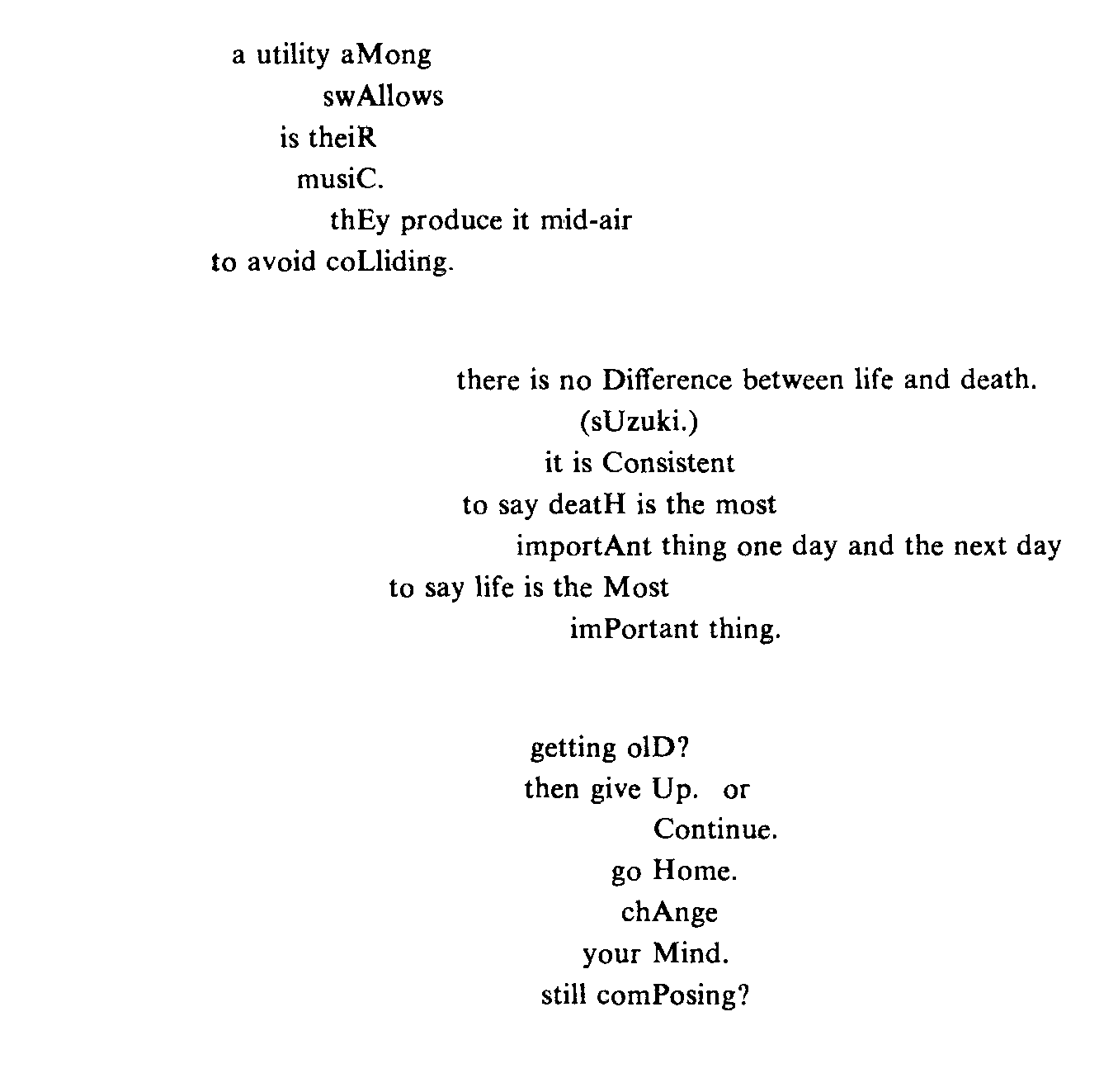
John Cage, 36 Mesostics Re and Not Re Duchamp (excerpt). From Cage, M: Writings ‘67–’72.
I perceive a thread of procedure—of means, if not of ends—running from Cage’s experiments with “de-militarizing” text through Burroughs et al., Tzara, much electro-acoustic music, and many Dylan lyrics. The idea of taking a more or less straightforward and “cutting it up” to create new and unexpected glimpses of meaning is an essentially optimistic idea: even in our fragments, our discarded shards, we find some meaning, some beauty.